Trojanized kubectl
Became a Cluster Breach
One endpoint bridge, one masqueraded binary, one privileged path to cloud control.
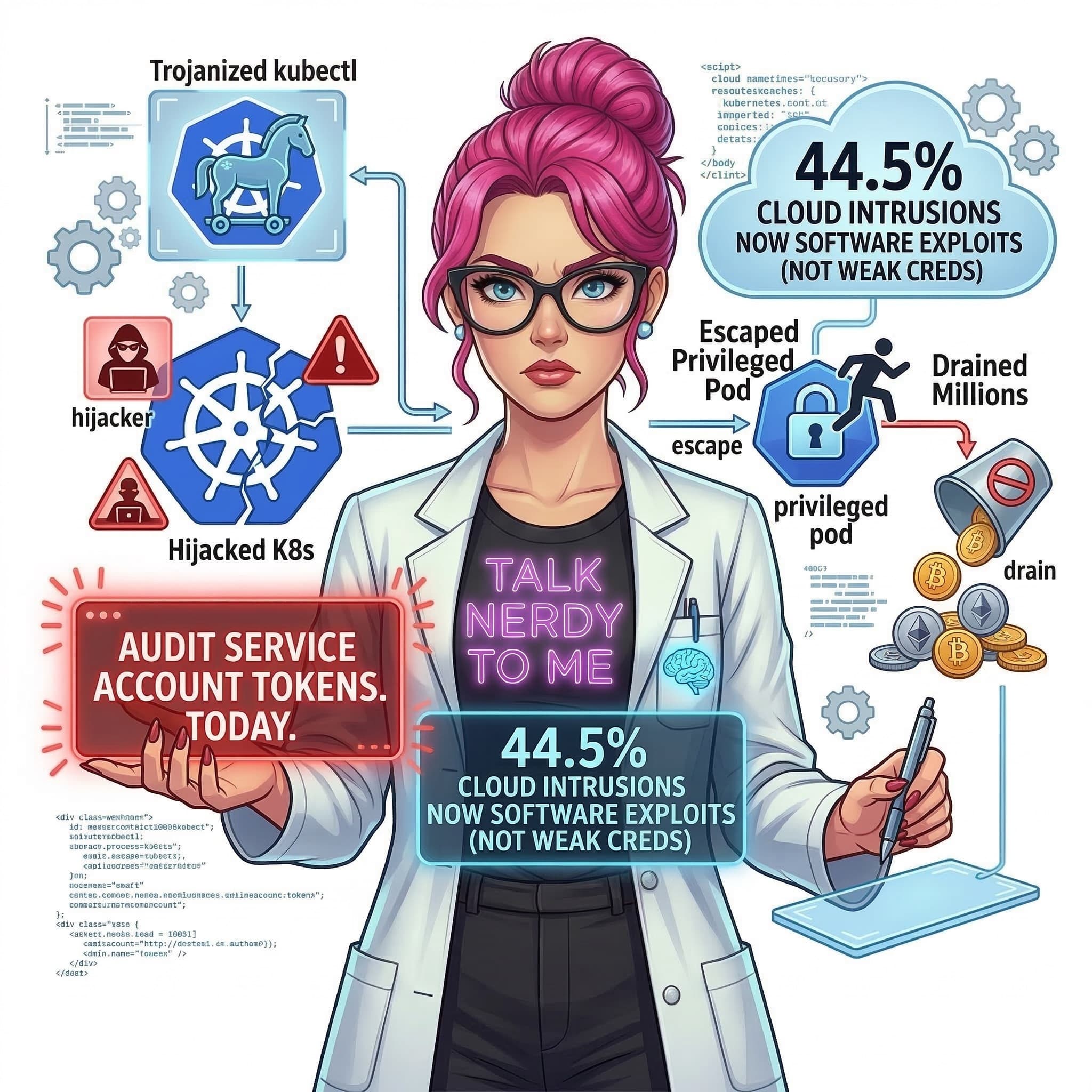
Google Cloud Threat Horizons H1 2026 details a real campaign where UNC4899 used social engineering and a trojanized kubectl-like binary to pivot from a developer workstation into cloud control paths. This post breaks down the kill chain, the control failures, and the exact audits platform teams should run now.
Date context: the report was published in March 2026 and analyzes incidents from H2 2025, including this UNC4899 campaign.
Spark Mode: This Was Not Theoretical
Attackers did not brute-force a password. They exploited a human workflow, weaponized a trusted tool path, and rode legitimate DevOps mechanisms all the way to financial theft.
The hard part is not understanding the kill chain after the fact. The hard part is removing the defaults that make this chain possible in the first place.
Verified Report Signals
44.5%
software vulnerabilities as initial access
In H2 2025, software exploitation surpassed weak credentials as the primary initial access vector in Google Cloud incident observations.
27.2%
weak or absent credentials
Credential-based entry declined versus H1 2025, but identity abuse remained central in most cloud incidents.
13.6%
RCE share in initial access
Remote code execution in observed incidents rose from 2.9% (H1 2025) to 13.6% (H2 2025), roughly a 5x increase.
83%
incidents with identity issues
Identity-related problems remained a major factor in cloud/SaaS incidents handled by Mandiant in H2 2025.
Kill Chain Dissection
Initial social engineering + personal-to-corporate bridge
A developer was lured into downloading an archive and transferred it from personal device to corporate workstation via AirDrop.
Control gap:Unrestricted P2P transfer pathways into corporate developer endpoints.
Execution of trojanized tooling
Embedded Python executed a binary masquerading as kubectl, establishing backdoor access to attacker-controlled infrastructure.
Control gap:Endpoint binary integrity and process-tree detection were insufficient.
Cloud pivot and LOTC progression
Actors pivoted to cloud resources, performed reconnaissance, and altered Kubernetes deployment configs for persistence.
Control gap:Session/token abuse and weak runtime drift detection.
CI/CD token harvesting from logs
Attackers injected commands to output service account tokens into logs, then abused a high-privileged CI/CD account.
Control gap:Secret hygiene and least-privilege failures in CI/CD identities.
Privileged pod abuse and node-level access
Using stolen token access to a sensitive privileged pod, actors bypassed isolation boundaries and established persistence.
Control gap:Privileged workloads and cluster-admin pathways left exploitable.
Database manipulation and crypto theft
Actors extracted static DB credentials, modified account security attributes, and withdrew several million dollars in cryptocurrency.
Control gap:Static secrets in workloads and insufficient blast-radius segmentation.
Audit These Now
1. Privileged Pod Inventory
# List pods using privileged=true (containers + initContainers)
kubectl get pods -A -o json | jq -r '
  .items[]
  | select(
      any(.spec.containers[]?; .securityContext.privileged == true) or
      any(.spec.initContainers[]?; .securityContext.privileged == true)
    )
  | [.metadata.namespace, .metadata.name] | @tsv
'
2. Token Leakage in CI/CD and Runtime
# Quick scan for leaked cloud/service-account credentials in CI log exports
rg -n --hidden   -e 'ya29\.[0-9A-Za-z\-_]+'   -e 'service[_-]?account.*token'   -e '-----BEGIN (RSA|EC|OPENSSH) PRIVATE KEY-----'   ./ci-logs ./build-artifacts || true

# Also flag workloads that still automount SA tokens by default
kubectl get pods -A -o json | jq -r '
  .items[]
  | select(.spec.automountServiceAccountToken != false)
  | [.metadata.namespace, .metadata.name, (.spec.serviceAccountName // "default")] | @tsv
'
3. kubectl Binary Integrity
#!/usr/bin/env bash
set -euo pipefail

# Verify local kubectl against your internally approved checksum manifest.
# Do not trust ad-hoc internet copy/paste during incident response.

BIN_PATH="$(command -v kubectl)"
APPROVED_MANIFEST="/etc/security/kubectl-approved-sha256.txt"
HOST_ID="$(hostname)"

EXPECTED_SHA="$(awk -v h="$HOST_ID" '$1 == h {print $2}' "$APPROVED_MANIFEST" || true)"
ACTUAL_SHA="$(shasum -a 256 "$BIN_PATH" | awk '{print $1}')"

if [[ -z "$EXPECTED_SHA" ]]; then
  echo "No approved kubectl hash found for host: $HOST_ID" >&2
  exit 2
fi

if [[ "$ACTUAL_SHA" != "$EXPECTED_SHA" ]]; then
  echo "kubectl integrity FAILED: $ACTUAL_SHA != $EXPECTED_SHA" >&2
  exit 1
fi

echo "kubectl integrity OK"
Blueprint Mode: Use the Full Defense Playbook
The companion playbook includes a 0-4h containment runbook, 72h recovery sequence, 30-day hardening plan, policy snippets, and a tabletop scenario pack for platform teams.
Sources
Attribution note: Google assesses UNC4899 involvement with moderate confidence. External coverage is used for corroboration, while control and metric guidance in this post is derived from the Google report itself.
Related Posts
TeamPCP Poisoned the Security Tools in Your CI/CD Pipeline
The March 2026 TeamPCP campaign did not just hit application dependencies. It moved through the security and developer tooling layer itself: Trivy, Checkmarx KICS, and LiteLLM release paths. This post breaks down what appears verified, what remains reported attribution, and the controls that would have cut the chain early.
47 Known CVEs Just Deployed to Production: Why Container Image Scanning Isn't Optional
A developer pulls a base image from Docker Hub, builds their app on top, and ships it. Nobody checks what's inside that base layer. 87% of container images in production carry high-severity CVEs. Here's how to shift-left on container security with scanning, digest pinning, distroless images, and approved base image registries.
DevSecOps for the Agent Era: The Security Gap Nobody's Talking About
Three CVE vulnerabilities hit Anthropic's MCP Git server. Docker acquired MCP Defender for runtime agent security. OWASP published a dedicated Top 10 for Agentic Applications. AI agents are shipping to production — but the security model hasn't caught up. Here's the agent security playbook.