Copilot vs Claude Code vs Amazon Q
For DevOps Work
Most comparisons are marketing dressed as analysis. This one is evidence-first.
Most AI assistant comparisons mix marketing claims, model benchmarks, and tool UX in one chart. This guide separates verified data from external estimates, compares architecture fit for DevOps workflows, and gives a reproducible AI DevOps benchmark harness of five real tasks for your own stack.
Last verified against source links on March 9, 2026.
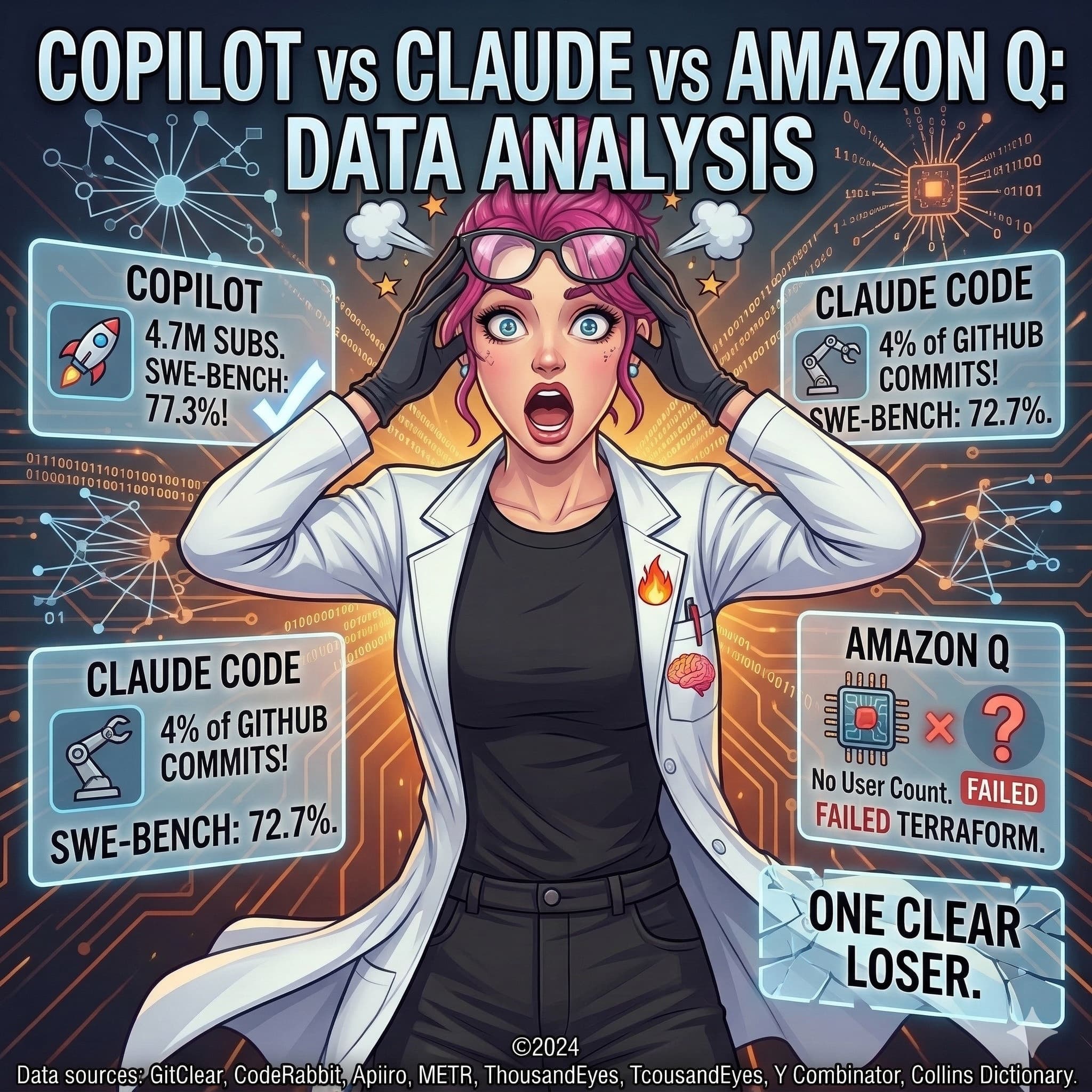
Layer 1: Market Position
The architecture discussion is useless without distribution reality. Install base, workflow surface area, and disclosure quality matter as much as model quality.
GitHub Copilot
Installed-base leader with enterprise distribution
Microsoft disclosed 4.7 million paid GitHub Copilot subscribers in its FY26 Q2 earnings call (February 4, 2026).
GitHub reported 20M+ all-time users and 77,000+ organizations using Copilot (October 2025).
Copilot runs across GitHub, VS Code, Visual Studio, JetBrains, and other supported environments.
Claude Code
Terminal-native agent with growing enterprise pull
Anthropic positions Claude Code as an agentic CLI for multi-step coding workflows with direct tooling and command execution.
Anthropic has published model-level performance gains and explicit token pricing; enterprise seat counts for Claude Code are not publicly broken out.
Widely cited run-rate and “share of commits” figures exist in external market coverage, but those are not audited product disclosures.
Amazon Q Developer
Strong AWS-native posture, narrower cross-cloud narrative
AWS publishes benchmark claims and continuous product updates for Q Developer.
AWS documentation emphasizes AWS workflow depth (including Java modernization paths and native integrations).
Public paid-subscriber/ARR metrics for Q Developer are not disclosed in the same way Microsoft disclosed Copilot subscriber figures.
Layer 2: What the Benchmarks Actually Show
Public benchmark claims exist, but they come from different dates, model versions, harnesses, and execution environments. Treat leaderboard snapshots as directional, not final.
GitHub product blog (April 2025)
GitHub Copilot coding agent (with Claude Sonnet 3.7 at the time)
56.0% SWE-bench Verified
Clear proof of agent workflow progress, but this is not a current 2026 apples-to-apples number versus latest models.
Anthropic model release data
Claude Sonnet 4.5 (model-level)
77.2% SWE-bench Verified
Strong model benchmark signal. Important caveat: model-level scores are not the same as end-to-end tool UX in Copilot or Q.
AWS DevOps blog (September 2025)
Amazon Q Developer agent for feature development
66% SWE-bench Verified, 49% SWT-bench Verified
AWS publishes concrete benchmark numbers for Q Developer. As with others, harness details and task mix matter for real-world transferability.
Benchmark caution: OpenAI and SWE-bench maintainers have both published warnings about contamination and benchmark gaming risks. If your decision is production-impacting, run your own task harness before standardizing a tool.
Layer 3: Where They Break in DevOps
Where Copilot Breaks
Great in-editor flow for single-file and nearby-context work.
Cross-repo or high-entropy infra reasoning still depends on prompt quality, repo context, and guardrails around agent runs.
Benchmark outputs can look strong while real incident triage still fails without environment signals and logs.
Where Claude Code Breaks
Autonomy is powerful for multi-step infra tasks, but cost visibility needs team policy and spend guardrails.
Terminal-native workflows can increase blast radius if tool permissions are broad.
Without strict review gates, fast generation can outrun architectural correctness.
Where Amazon Q Breaks
Q shines when task context is deeply AWS-specific and aligned to AWS tooling.
Cross-cloud abstractions and non-AWS operational stacks are a weaker narrative in public benchmarks and docs.
If your workflow spans mixed providers and heterogeneous toolchains, portability strategy matters more than benchmark headline numbers.
The Part Nobody Mentions
The core battle is not brand vs brand. It is architecture vs architecture: IDE-native autocomplete versus autonomous agent loops.
Copilot is moving from inline assist toward autonomous workflows. Claude Code is moving from terminal-first autonomy toward richer IDE integration. Amazon Q is strongest where AWS context density is highest.
For platform teams, architecture fit matters more than hype cycles. Pick the tool that matches your workflow topology and control model, not the loudest launch thread.
DevOps Decision Guidance
Multi-cloud platform team with heavy Terraform/Kubernetes operations
Favor terminal-native and high-context workflows first; evaluate Copilot/Q as augmenters, not primary orchestrators.
VS Code-first software teams with light infrastructure touch
Copilot is the low-friction default due workflow integration and broad organizational footprint.
AWS-centric modernization (especially Java transformation tracks)
Q Developer has a clear niche where AWS-native leverage can outweigh weaker cross-cloud portability.
Run This Before You Buy Anything
Use your own incidents, your own Terraform standards, and your own CI/CD controls. Vendor demos test vendor strengths. This tests your reality.
# TNTM 5-task DevOps benchmark harness

task_1:
  name: terraform_module_generation
  pass_criteria:
    - terraform_validate_passes
    - no_hallucinated_provider_arguments
    - variables_outputs_naming_policy_enforced

task_2:
  name: intent_to_iac_composition
  input_example: "2 web apps, 1 key vault, private endpoints, staging + prod"
  pass_criteria:
    - dependency_graph_valid
    - environment_isolation_clear
    - state_boundary_explicit

task_3:
  name: kubernetes_incident_triage
  pass_criteria:
    - ordered_diagnostic_steps
    - evidence_based_hypothesis
    - rollback_path_included

task_4:
  name: cicd_migration
  pass_criteria:
    - approval_and_secret_controls_preserved
    - pipeline_parity_with_source_system
    - no_unsafe_default_deploy_paths

task_5:
  name: security_review
  pass_criteria:
    - privilege_escalation_risks_flagged
    - destructive_ops_require_human_gate
    - actionable_remediation_notes
Bottom Line
If your workloads are infra-heavy and cross-file, terminal-native agents are currently more natural. If your team is deeply IDE-centric and policy-driven, Copilot remains the safest baseline. If you are AWS-first and modernization-heavy, Q has a real lane. Pick by workflow fit, then validate with your own benchmark harness.
See More TNTM AnalysisSources
Related Posts
MCP Is the USB-C of DevOps: The Governance Playbook Teams Need Before the First "Deploy Staging" Prompt
MCP has crossed from demo protocol to real platform plumbing for DevOps workflows, but the blocker is not model quality. It is governance: transport choices, identity, approval gates, server trust, auditability, and rollout discipline. This guide separates hype from what is actually production-relevant in Q1 2026.
GitHub Agent HQ: Claude & Codex Join Copilot in a Unified AI Coding Dashboard
GitHub just launched Agent HQ — a unified dashboard inside GitHub, GitHub Mobile, and VS Code that lets Copilot Pro+ and Enterprise users run Claude, OpenAI Codex, and Copilot agents without leaving their repo or PR. With 20M+ Copilot users and 90% Fortune 100 adoption, the "best AI coding tool" debate just became "best AI coding workflow."
Terraform Actions Block: The Complete Guide to Day 2 Operations in IaC
Terraform 1.14 introduced the `action` block — and it quietly solved the problem every cloud engineer has worked around for years. Invalidate a CDN. Run a database migration. Send an alert. All from within the plan/apply lifecycle, no bash scripts required. Here's the complete picture: syntax, catalog, pitfalls, and the OpenTofu fork you need to understand before you ship this to shared modules.