Your AI Agent Has More Access
Than Your Junior Devs
And Nobody Is Auditing It Like Production Access
AI agent security is no longer theoretical. Verified 2026 data shows widespread skill-level vulnerabilities, real malicious payloads, and measurable incident increases when agents are over-privileged. This guide translates the latest evidence into a least-agency security model for infrastructure teams.
Last verified against primary sources on March 2, 2026.
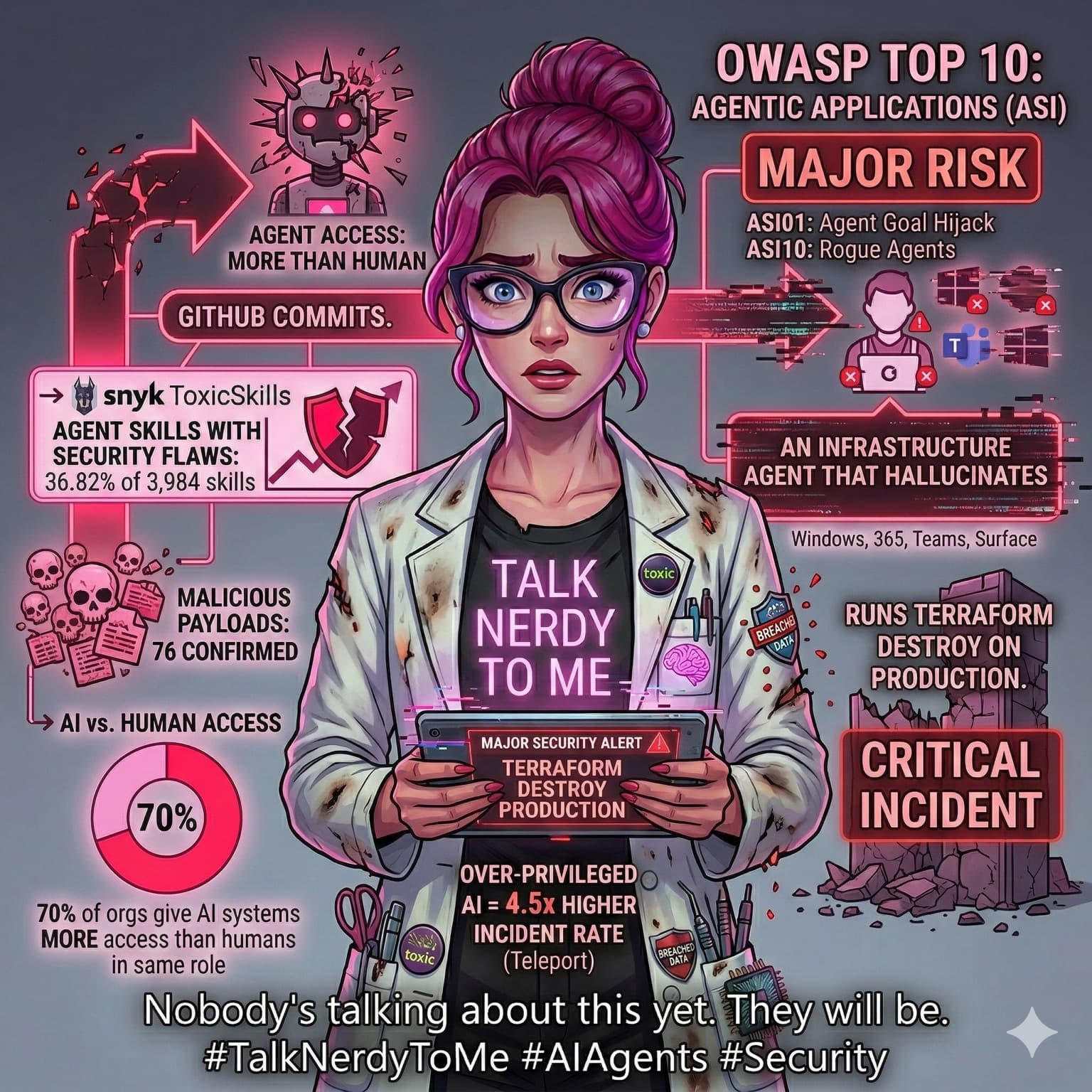
This Is Not a Future Risk
AI agents now execute real operations: reading secrets, calling cloud APIs, applying IaC, and mutating CI/CD state. The question is no longer model quality. The question is permission design.
If your agent can perform production actions that your junior engineers cannot, you have a governance failure. The fix is explicit least-agency architecture, enforced through identity, policy, and approvals.
Better model outputs do not fix over-privileged execution paths.
Verified 2026 Signal, Not Hype
36.82%
skills with security flaws
Snyk audited 3,984 MCP/agent skills and found 1,467 with vulnerabilities.
76
confirmed malicious skills
Snyk reports credential theft, backdoors, and exfiltration payload patterns.
70%
orgs over-privilege AI systems
Teleport surveyed 205 CISOs; over-privileged orgs reported 4.5x more incidents.
5
top OWASP agentic risks to start with
Goal hijack, tool misuse, identity abuse, supply-chain compromise, and code execution.
You may see larger campaign counts in secondary posts. This article keeps only figures we can trace to primary sources published by security vendors, OWASP, or CVE/advisory databases.
The Infrastructure Risk Nobody Budgets For
Application teams usually think in terms of prompt safety. Platform teams have to think in blast radius: what can this identity mutate if a tool call is wrong, poisoned, or hijacked?
IaC Mutation
Unscoped access can convert a hallucinated fix into destructive Terraform actions.
Credential Spread
Cached long-lived keys can turn one compromised agent run into cross-environment access.
Memory Poisoning
Manipulated context can rewrite agent goals and trigger valid-but-dangerous operations later.
This is why OWASP frames the control objective as least agency: give the agent only the autonomy and tool power required for that single task, no more.
OWASP Top-5 to Model First
Agent Goal and Instruction Manipulation
Agent Tool Misuse
Agentic Identity and Access Management Weaknesses
Agent Supply Chain Vulnerabilities
Agent Improper Output Handling
Least-Agency Control Stack
Split agent identities by environment and task type (read-only triage, plan-only IaC, apply-capable release bot).
Use short-lived credentials only. Never let long-lived cloud keys sit in agent memory or local config.
Default to read-only tools. Promote to mutating tools only inside approved workflows with human checkpoints.
Constrain blast radius: repo scope, namespace scope, subscription/account scope, and explicit deny-lists for destructive APIs.
Treat skill/tool onboarding like dependency onboarding: provenance checks, version pinning, and continuous scanning.
Log every tool call and policy decision to SIEM with actor, prompt hash, tool name, arguments hash, and outcome.
Reference Profile: Plan-Only Infra Agent
Start with a non-destructive profile and force all mutating operations into approved CI workflows. This one pattern removes most catastrophic failure paths while preserving speed.
version: 1
profile: infra-agent-plan-only
identity:
  type: workload_identity
  ttl_minutes: 15
permissions:
  github:
    repositories:
      - org/platform-infra
    scopes: ["contents:read", "pull_requests:write"]
  cloud:
    actions:
      - "terraform:plan"
      - "terraform:validate"
    deny:
      - "terraform:destroy"
      - "iam:CreateAccessKey"
      - "kubernetes:cluster-admin"
controls:
  human_approval_required_for:
    - "any_mutating_operation"
  logging:
    destination: "siem"
    include:
      - actor
      - prompt_hash
      - tool_name
      - args_hash
      - decision
30-Day Implementation Playbook
Days 0-7 | Access Inventory
List every AI-capable tool, assistant, skill package, and MCP server used in engineering workflows.
Map effective permissions for each identity (human-assumed, service account, workload identity).
Classify each capability as read, write, execute, or destructive.
Days 8-21 | Policy Enforcement
Create least-agency policy profiles for triage, code review, docs, IaC plan, and IaC apply.
Move IaC apply and production mutations behind approval gates in CI/CD only.
Add deny-by-default guardrails for `terraform destroy`, privileged kubectl verbs, and secrets APIs.
Days 22-30 | Detection and Drills
Publish an incident runbook for prompt injection, memory poisoning, and malicious skill execution.
Run one tabletop exercise using a simulated poisoned skill update.
Track policy violations and time-to-revoke metrics in your weekly platform review.
Security Outcome to Target
An agent should never be able to do in production what a scoped human operator could not do under the same policy. If your architecture fails that test, it is not agentic maturity. It is privileged automation debt.
Use the Governance Rollout KitSources
Related Posts
MCP Is the USB-C of DevOps: The Governance Playbook Teams Need Before the First "Deploy Staging" Prompt
MCP has crossed from demo protocol to real platform plumbing for DevOps workflows, but the blocker is not model quality. It is governance: transport choices, identity, approval gates, server trust, auditability, and rollout discipline. This guide separates hype from what is actually production-relevant in Q1 2026.
DevSecOps for the Agent Era: The Security Gap Nobody's Talking About
Three CVE vulnerabilities hit Anthropic's MCP Git server. Docker acquired MCP Defender for runtime agent security. OWASP published a dedicated Top 10 for Agentic Applications. AI agents are shipping to production — but the security model hasn't caught up. Here's the agent security playbook.
GitHub Agentic Workflows: The Decision Framework Nobody's Talking About
Everyone's excited about AI in CI/CD. Nobody's asking when to use it vs when not to. GitHub Agentic Workflows just entered technical preview — the architecture is solid. But the real decision isn't which agent to pick. It's when to use agentic workflows vs deterministic ones. Here's the decision framework, the adoption pattern, and the three questions to answer before you deploy.